

The fact today is that every broadcaster, sports league, and media companies are sitting on a goldmine they can barely access. Thousands of hours of footage – games, live events, raw shoots, archival content, that are stored across drives and servers, searchable only through whatever tags someone remembered to add. The assumption has long been that the hard part of video is capturing it. The harder part, it turns out, is finding anything in it.
The Footage Nobody Talks About:
Most folks imagine video content as what ends up on screen – a game recap, a news clip, a tight doc sequence. But for every minute of content that goes live, there are anywhere from ten to two hundred minutes of raw, uncut footage that preceded it. That pile of unused clips? Experts label it the shooting ratio:
- Typical digital productions: 10:1 to 30:1
- Documentaries: 20:1 to 80:1
- Large-scale sports or action productions: 200:1 or more
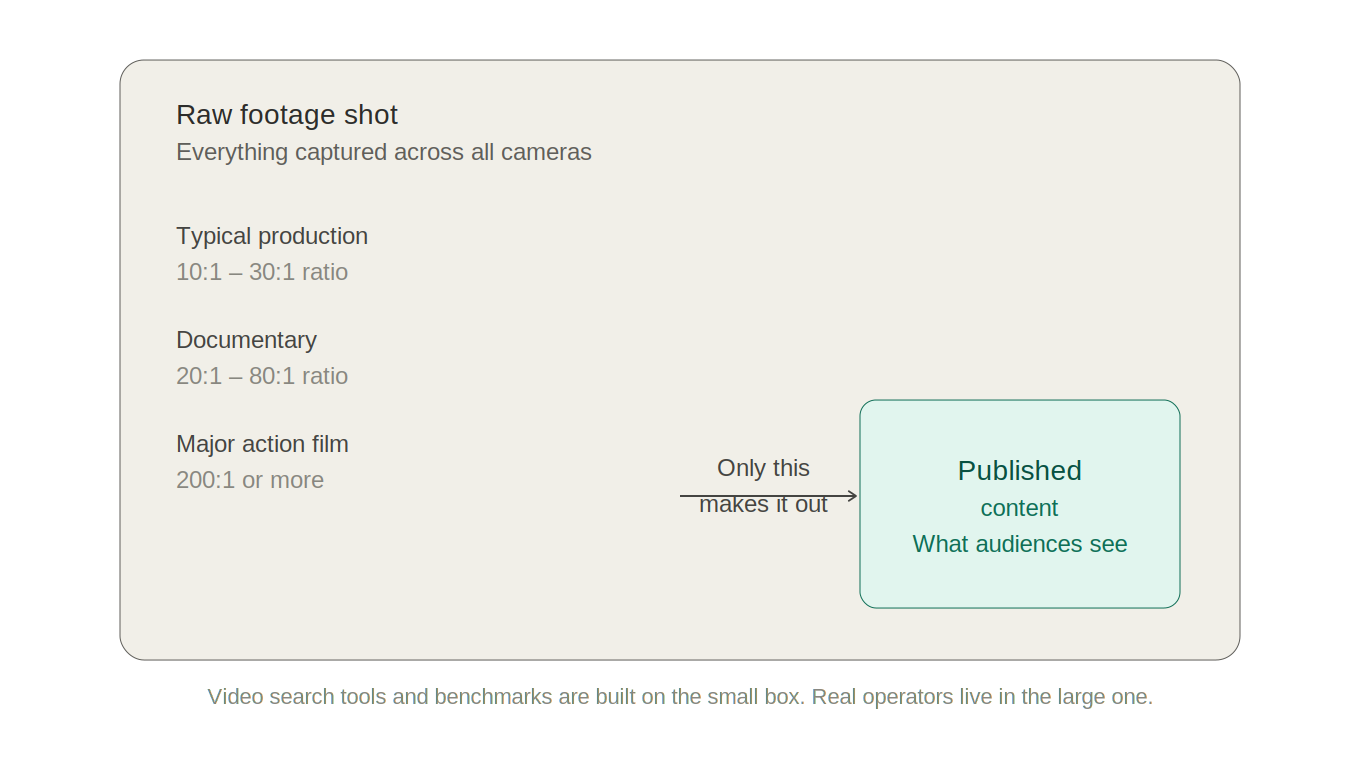
That raw footage is where the real operational challenge lives. A sports broadcaster finishing a post-match show doesn’t need help understanding the edited broadcast. They need to locate:
- A specific tackle or foul from a precise timestamp
- A coach’s sideline reaction to a controversial call
- A disputed off-the-ball incident buried across eight simultaneous camera feeds
The finished broadcast is the tip of the iceberg. Everything below the waterline is what production teams actually wrestle with every day.
Why Current Tools Fall Short?
Most enterprise video libraries today rely on one of two approaches: manual metadata tagging or keyword search. Both are deeply limited.
Manual tagging requires someone to watch footage and annotate it. At scale, this is economically unsustainable. Even when tags exist, they only reflect what the tagger noticed and chose to record – anything missed is permanently invisible to search. The core problems with traditional approaches:
Manual tagging breaks down at volume – a broadcaster processing four live games a day cannot afford a human logging every timestamp.
Keyword search only surfaces what was labelled – search for “goalkeeper error” and find nothing if the clip was only tagged “goal”
General-purpose AI models are architecturally expensive – they handle only short clip lengths per call, forcing you to arbitrarily slice footage into disconnected fragments.
LLM-based video search can cost up to 10x more than purpose-built semantic alternatives, making daily large-scale use financially unviable for most organisations

The Segmentation Problem:
This is where the real technical difficulty lives, and it’s one that most off-the-shelf solutions quietly avoid addressing. Video has a natural hierarchy:
- A football match contains halves → possessions → individual actions
- A news archive contains programmes → segments → specific statements or events
- A documentary contains chapters → scenes → individual interview moments
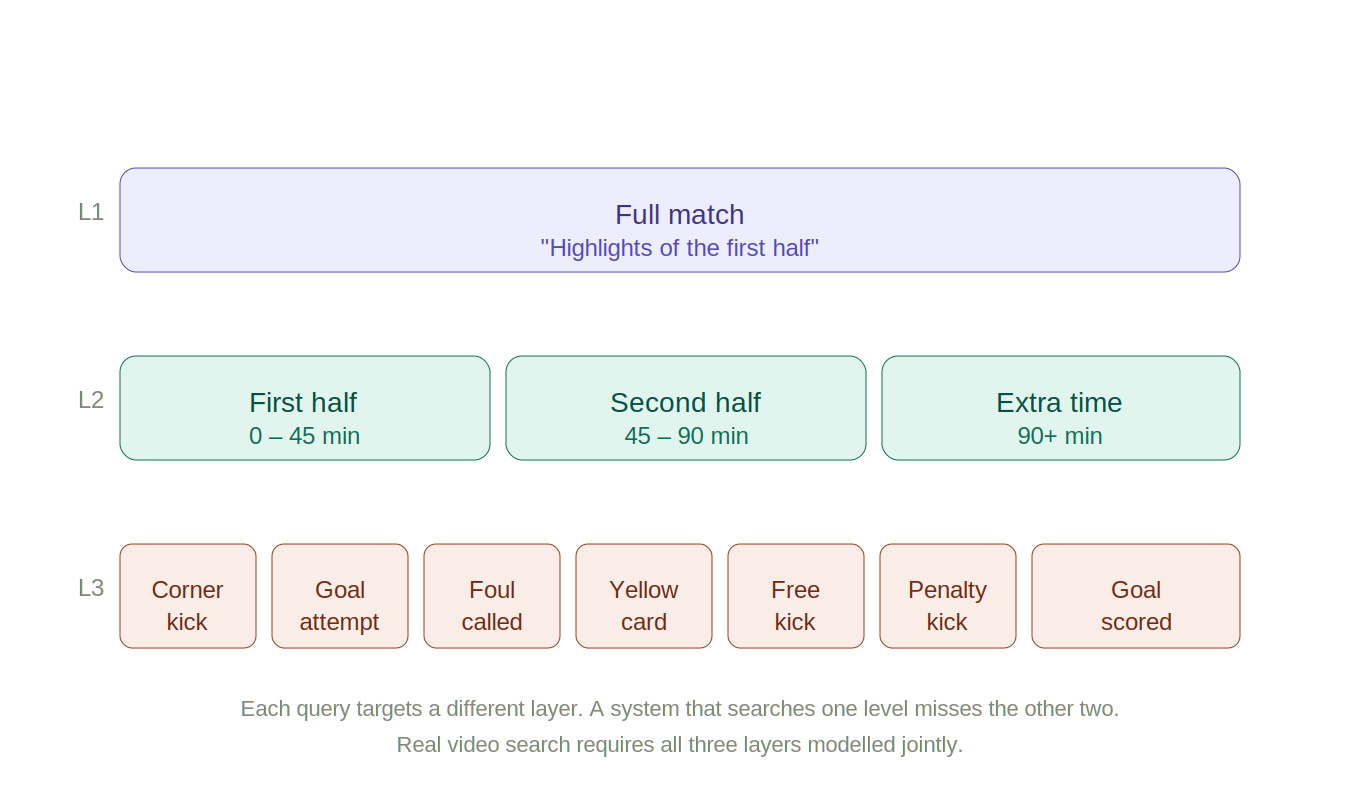
When someone searches for “all corner kicks in the second half,” the system needs to understand that query at multiple levels simultaneously – isolating the right half, finding the right action type, then returning clips at the correct granularity. A system that only works at one level will either miss context entirely or drown the user in irrelevant results.
True semantic video search requires modelling these layers jointly, as part of a single unified understanding of the video’s structure – not as separate passes. This is fundamentally different from what basic AI tagging or keyword search was ever designed to solve.
What Semantic Search Actually Means in Practice?
The term “semantic search” gets used loosely, so it is worth being precise. Semantic search means searching by meaning rather than by label. In practice, this looks like:
- Finding “player limping off the pitch” even if no one ever typed that phrase in the metadata.
- Locating a specific crowd reaction without knowing which camera captured it or when Surfacing a coach’s tactical instruction from sideline audio without a transcript.
- Identifying a product placement moment in archival footage for commercial licensing.
For this to work, the system needs to jointly understand text, image, and audio signals together. A player collision looks different depending on angle, lighting, and distance – but the crowd reaction, commentary audio, and visual dynamics all point to the same event. A genuinely multimodal approach reads all of these signals simultaneously and connects them.
Domain specificity matters enormously here too. A general model trained on broad internet data understands a tackle abstractly. A sports-trained model has the visual vocabulary to distinguish a clean sliding tackle from a dangerous one. Vertical-specific training produces a meaningfully different level of accuracy for real production use.
The Cost and Speed Gap:
Beyond accuracy, there is a practical operational argument that rarely gets enough attention. Here is what purpose-built semantic video search delivers versus legacy alternatives:
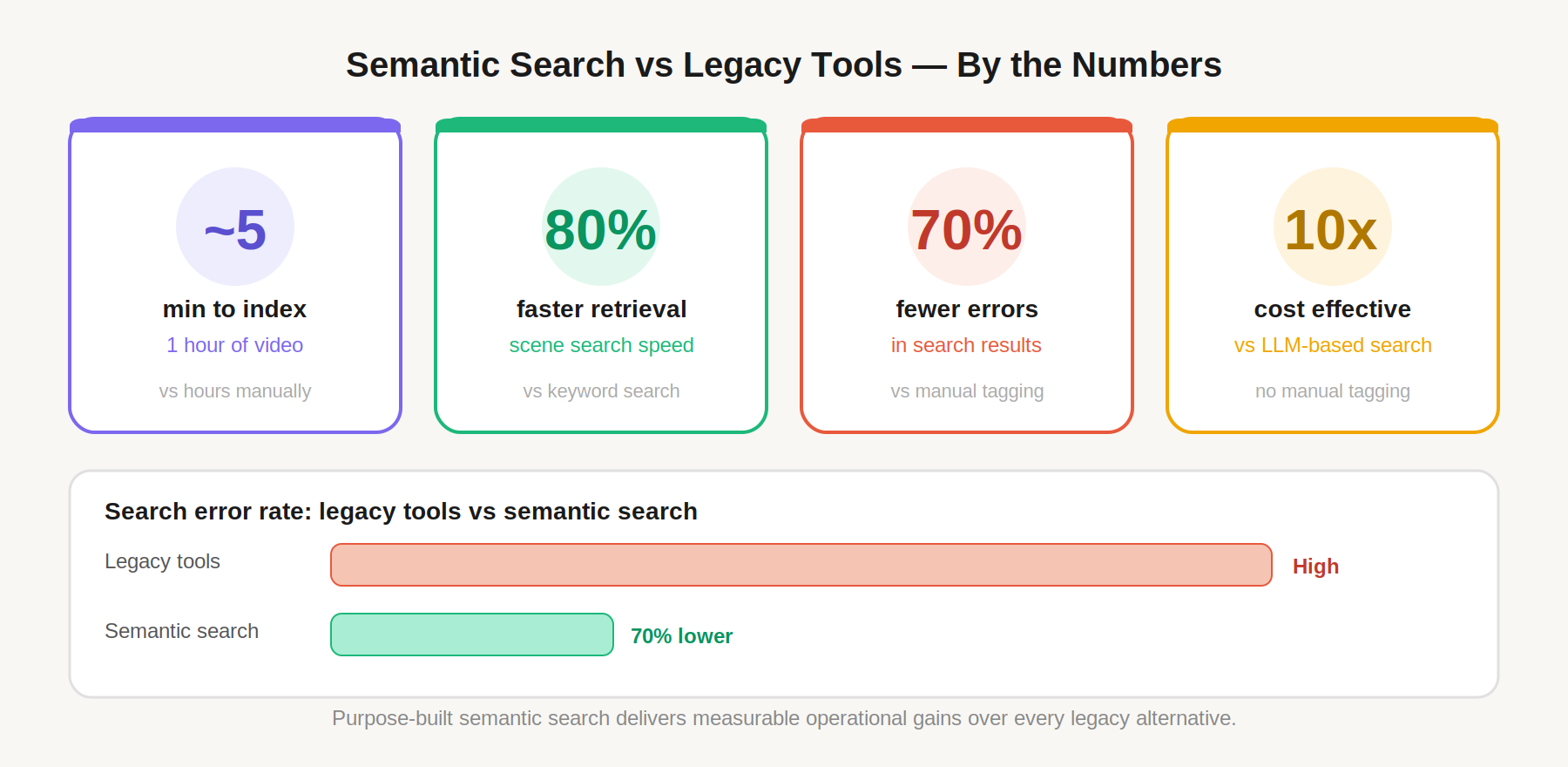
- ~5 minutes to process and index one hour of video.
- 80% faster scene retrieval compared to traditional search methods.
- 70% reduction in search errors, meaning analysts find what they need without escalating to manual review.
- Up to 10x more cost-effective than LLM or metadata-based search approaches.
- Zero manual tagging required – no metadata, no labels, no human annotation pipeline.
These are not marginal improvements. They change what a team can realistically do with their archive on a daily operational basis.
The Archive as an Asset:
There is a broader shift happening in how media organisations think about their footage. For most of the industry’s history, archives have been treated as storage costs – content was produced, broadcast, and filed away. Retrieval was manual, slow, and expensive enough that it only happened when the value clearly justified the effort.
Semantic search changes that calculus entirely. When footage becomes instantly queryable by meaning, the archive becomes a live asset that powers:
- Real-time highlights packaging for social and broadcast.
- Compliance and rights management reviews.
- Investigative journalism and news verification.
- Athlete and performance analysis databases.
- Commercial licensing and content monetisation.
The footage has always been there. What was missing was a way to actually use it.


